

A flexible heater is a chemically etched, screen printed, or wire wound heater that can be bent or flexed to conform to the contours of the surface that needs to be heated. There are many types of flexible heaters, including silicone rubber heaters (etched and wire wound), polyimide/Kapton® film heaters, carbon printed heaters, and transparent heaters. All of these heaters are available in a variety of different variations, including the ability to customize size, shape, and thickness, as well as add components that can improve performance for any application.
Flexible heaters are rugged, reliable, accurate, efficient, and resistant to moisture and chemicals. Flexible heating elements have a wide range of industrial, commercial, and military applications because they can be easily bonded or adhered to any type and size of substrate, and can even be actively bent in applications. Flexible heaters are thin and lightweight, suitable for harsh environments, vacuum applications, and can operate at intermittent temperatures up to 500°F/260°C and continuous temperatures up to 392°F/200°C.
Efficient and effective heat transfer is key to the success of any heating application. Flexible heaters can be adhered directly to the surface that needs to be heated, which is the most effective way to ensure that heat energy is transferred from the heating element. If the heater is designed correctly and mounted properly so that there is a uniform interface between the heater and the substrate to be heated, then there is no better mechanism to choose from.
Many times, different sensors and controls can be built directly into the flexible heater. Preset or adjustable thermostats, thermocouples, thermistors, RTDs, thermal fuses and other electronic components are often included as part of the flexible heater design.
Polyimide is a thin, lightweight polymer film that has excellent tensile strength, tear resistance and dimensional stability. This material has been used in flexible PCBs for over 30 years and when used in heater applications, it provides low outgassing in a vacuum and resistance to radiation, fungus and many other substances. By using photoimaging technology, etched foil components will have excellent circuit pattern repeatability, resulting in lower production costs and superior heat transfer. This is due to the ability to place components very close to each other, providing a larger surface area.
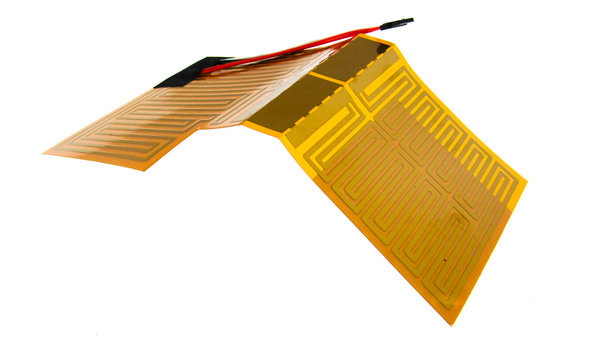
Polyimide Advantages
Excellent physical and electrical properties make it thermally stable over a wide temperature range.
Suitable for use in vacuum environments (NASA-RP-1061) and NASA-approved for space applications (S-311-P-079).
Resistant to most chemicals: oils, solvents, acids and bases.
Formable, flexible, and can be bonded to metals using a variety of adhesives.
Substrates can be coated with a variety of foil element alloys such as Inconel, Nickel, Copper, Nickel-Iron, and a variety of stainless steels.
Can provide twice the watt density of wirewound heaters.
Silicone Rubber Heaters
Etched circuit or wirewound heating elements are sandwiched between glass fiber reinforced silicone rubber, giving these heaters dimensional stability and efficient heat transfer capabilities without sacrificing flexibility. In etched foil designs, the inner foil may be the same as for polyimide heaters, but the silicone rubber provides reliable wear protection against mechanical damage and is more likely to be used in wet environments due to its rugged nature.
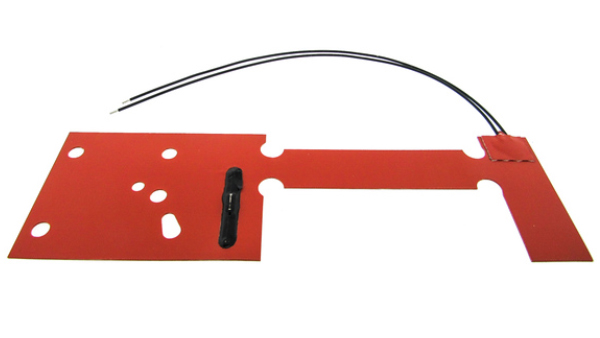
Silicone rubber also allows for the use of mechanical fasteners to mount and remove the heater, such as: latch fasteners, boot hooks, grommets, snap fasteners, springs, and tie cords. Additional heat distribution and heat shielding materials (most commonly aluminum and silicone sponge) can be added to any design to help improve any application.
Advantages of Silicone Rubber Heaters
Various geometries such as flat, molded shapes, and spiral wraps.
Can be used where multi-watt density is required.
Extremely resistant to moisture and chemicals.
Silicone rubber provides the best dimensional stability.
Heaters can be mounted directly to metal via the RTV vulcanization process.
Screen Printed Heaters
Screen printed heaters are made by screen printing specific inks onto flexible substrates such as polyester (PET), polyimide (PI), polycarbonate, and various other substrates. Flexible screen printed heaters can be produced using inks that allow the heater to self-regulate temperature, or as fixed resistance heater designs that require regulation by thermal control circuits. One of the most common uses for these heaters is in the automotive industry, where they are used to prevent ice from forming on side view mirrors or on cars, buses, and trucks.
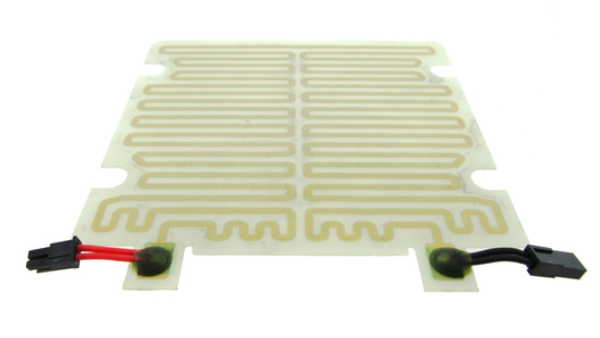
Advantages of screen-printed heaters
Low manufacturing cost.
Low operating power.
Even heating.


